Dear people of the past: this was a terrible, horrible, no good idea.
Sincerely,
The People of the Future. Continue reading
Dear people of the past: this was a terrible, horrible, no good idea.
Sincerely,
The People of the Future. Continue reading

Big patch, ugly paint color.
I didn’t take a before picture, but believe me when I tell you that the white areas in the photo above used to be a giant plaster bubble. So I popped it (because that’s the tempting thing to do with all blisters) and removed all the bits of plaster that were no longer attached to anything. Because this is a brick wall (there isn’t any lath behind this plaster) I though the normal way to fix bubbling plaster would not work all that well, since it involves special screws and special glue. Besides, who am I kidding? I’m just a beginner when it comes to plaster.
I had never fixed an area this big. Little bits of missing plaster? Sure! A few cracks here and there? No problem. But this? Uncharted plaster fun.
It was surprisingly easy, and to be super cliché: easy does it: many thin layers seems to be the way to go. While the first few layers are quite bumpy, each subsequent coating gets a little smoother. At least from a beginner’s standpoint, the biggest issue applying thicker layers: improper drying and shrinkage, which means the patch will crack. Again.
The dining room will tell whether we’re properly tending to the cracks. The big hole, pictured above, now looks like this:

One more pass and the skim-coating will be done, then prime and paint. Huzzah!
It seems that for the past 20 years (at least), the plaster at our house wasn’t properly maintained. Areas were haphazardly patched, but the underlying issues weren’t dealt with, like filling a cavity without removing the rotted bits of tooth. No stinking good.
For instance, bubbling plaster looks like this:
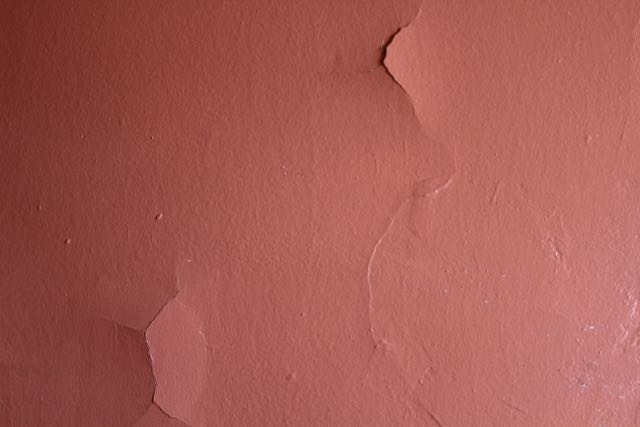
Top layer of plaster no longer attached. Bubble forms, and eventually a crack will follow.
And this is what a sloppy repair job looks like. Bubble is still there and the patch wasn’t sanded, just painted over with glossy paint (which, of course, is the least forgiving type of paint when it comes to bumpy surfaces).
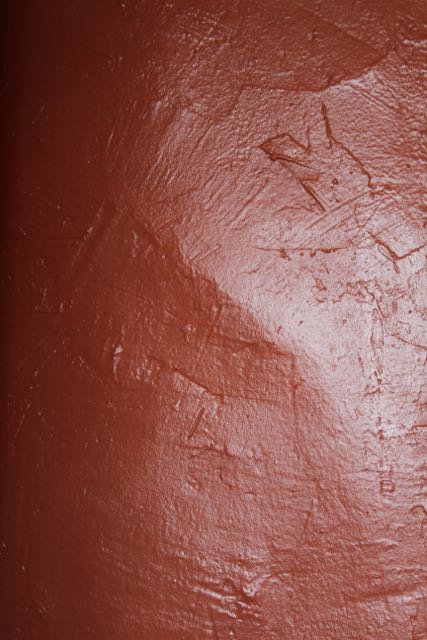
Muppet Flesh paint foh-ev-ah!
And just for funnzies, this is what a super huge monster-evil-super-villan crack looks like (this was courtesy of a leaky roof):

Repairing this crack will require removal of the plaster on either side and some mesh tape.
From our experience, simply patching over cracks is futile. It just feeds them and makes them stronger – like giving a donut to a Gremlin after midnight: they become EVIL! Old House Journal has a fabulous article about all things plaster.
It would probably be faster to remove all the plaster and replace with dry-wall. But since faster/easier doesn’t mean better, we’ll stick to the plaster, and its good sound dampening and fire resistant qualities. We’ll just remind ourselves of our love of plaster as we fix the many many many many cracks along the way.
Our parlor floor ceiling is a bit of a show-off. It’s not super fancy like some of the stuff you see in Cobble Hill, or Park Slope, but it’s enough to class up the joint.

There are harps and other delicate squiggles, some of which are showing signs of aging – cracks and patches and ample evidence of less than perfect repairs in the past.

If a plain plaster wall can make me swoon, a fancy plaster has me head over heels. I’m insanely protective of our parlor ceilings, which I suppose it’s an odd thing to say – but it’s true. I catch myself staring at it and taking inventory of every crack and poorly patched bit of plaster. It’s overwhelming sometimes because I have no idea how we are going to fix it. I’m sure a mold needs to be made, then what? While I’m getting pretty good at skim coating, I wouldn’t dare make this a DIY project. So, as with all things that require a budget, it will have to wait. For now, I’m keeping an eye out of any new damage, and hoping there is none.
(a random newspaper find)
Searching old documents online is awfully convenient. Digitized books, directories and newspapers are key in piecing together the history of a building and the people who lived there, and while the technology is pretty good (certainly beats sitting in a basement, sifting through microfiche), it’s far from perfect. The keyword search engine gets confused easily, particularly with numbers. If the scans aren’t clear, searches involving 3s, 5s, and 8s can get mixed up very easily.
Of course you can just skip past it and keep going. But you’d miss out on a nugget like this one:

Brooklyn Daily Eagle – Monday Sept 7, 1885
Happy Monday, I hope yours is better than Mrs. Culimore’s.
There has been a change in the construction crew at the gut reno project in my neighborhood.
(I say this as if there is only one. Sadly, there are many, but that’s fodder for another soapbox).
The construction foreman, who was saving me the stuff, is no more. It’s back to chucking everything onto the pile in the front yard. Sigh. It seems the same law of physics that makes the toast always land butter side down also dictates that anything worth saving is alway at the bottom of the pile.
(I am trying not to think about the intact garden level trim that was so carefully removed, now tossed)
Once in a while, however, there is good stuff to be found at the top. Case in point: a broken medicine cabinet. I found this when I accidentally/on purpose took the long way to the bodega.
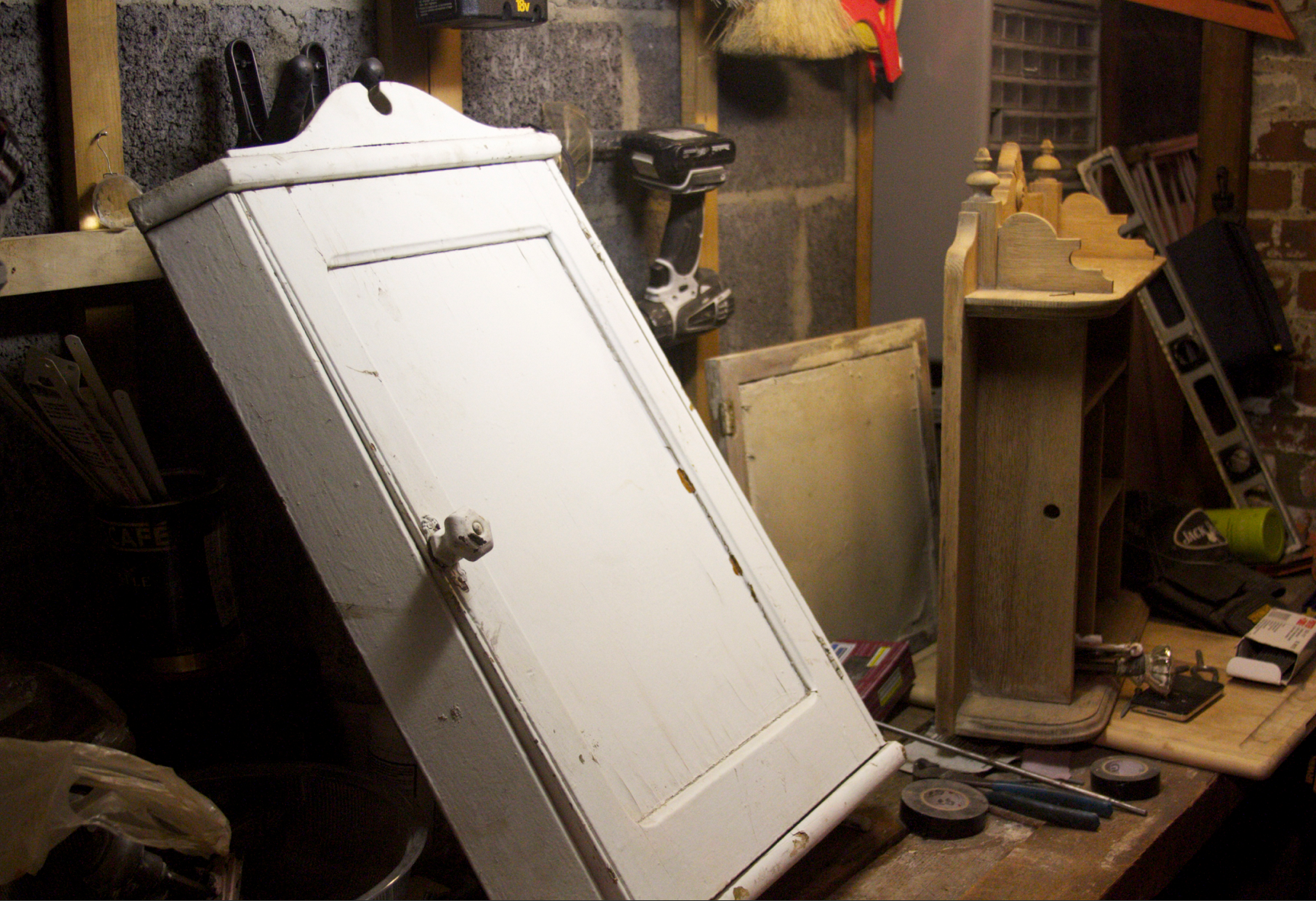
The mirror is long gone, but the worst part is that this cute little medicine cabinet was basically ripped out of the wall.
 The back is gone, as is one of the sides.
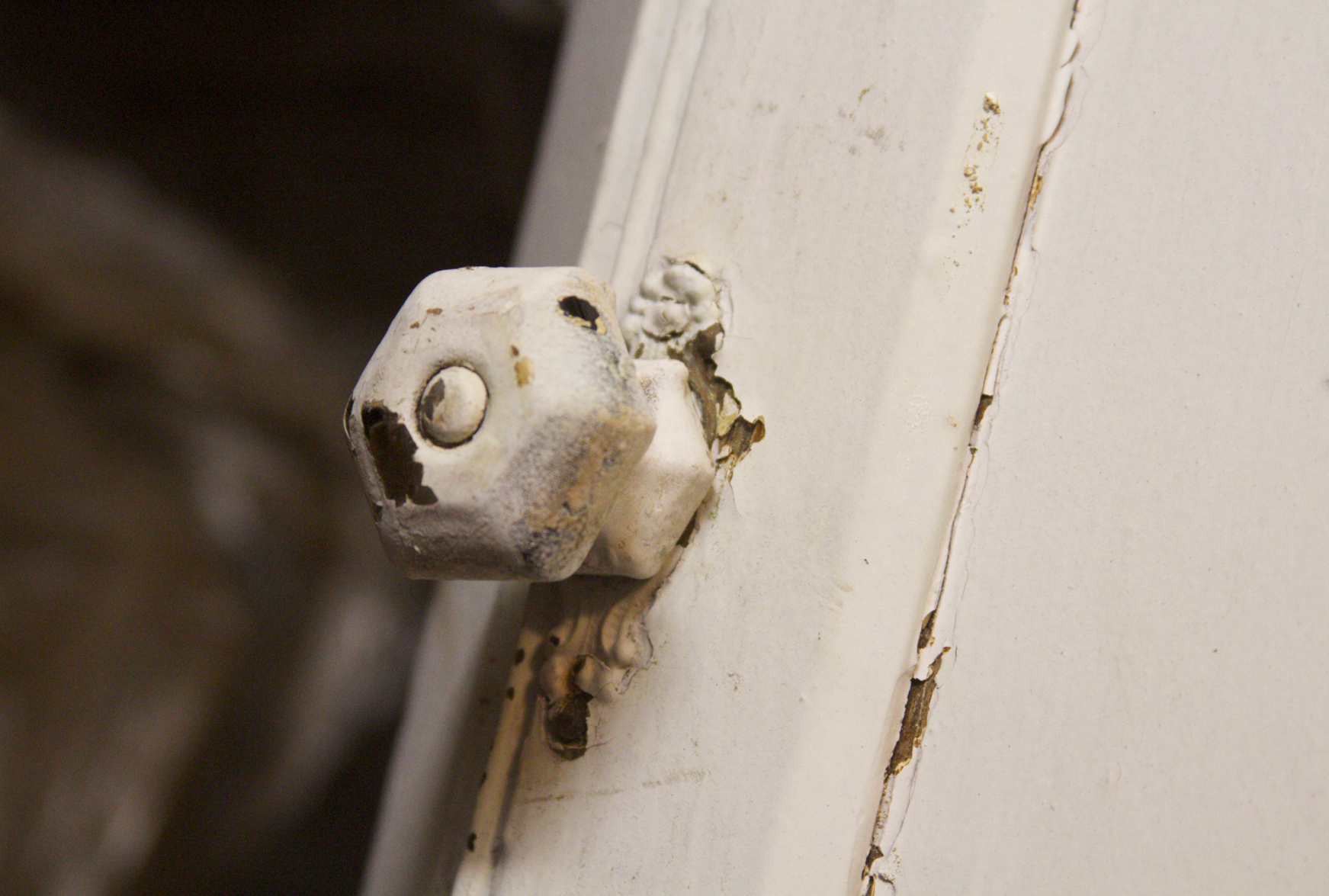
It has a pretty knob (probably not original) and a pretty piece of hardware underneath (not sure original to the cabinet, but it is of the period because we have the same kind in our house).

I think originally it had a locking latch, given the notched out part that has been filled (or is that the lock, hiding under all that paint?)

It’s covered in several thick layers of paint – but that’s pretty much every piece of woodwork in my life right now. I’m confident it can be made pretty again. As a point of comparison, this is what the medicine cabinet original to our house looks like mid strip. It too was shellacked in layers and layers of paint.

(lame flash photo. The overheads were casting a huge shadow inside, and I was too lazy to drag the big work light over).
It has all the pieces, including the locking latch (see notched out part on the left?)
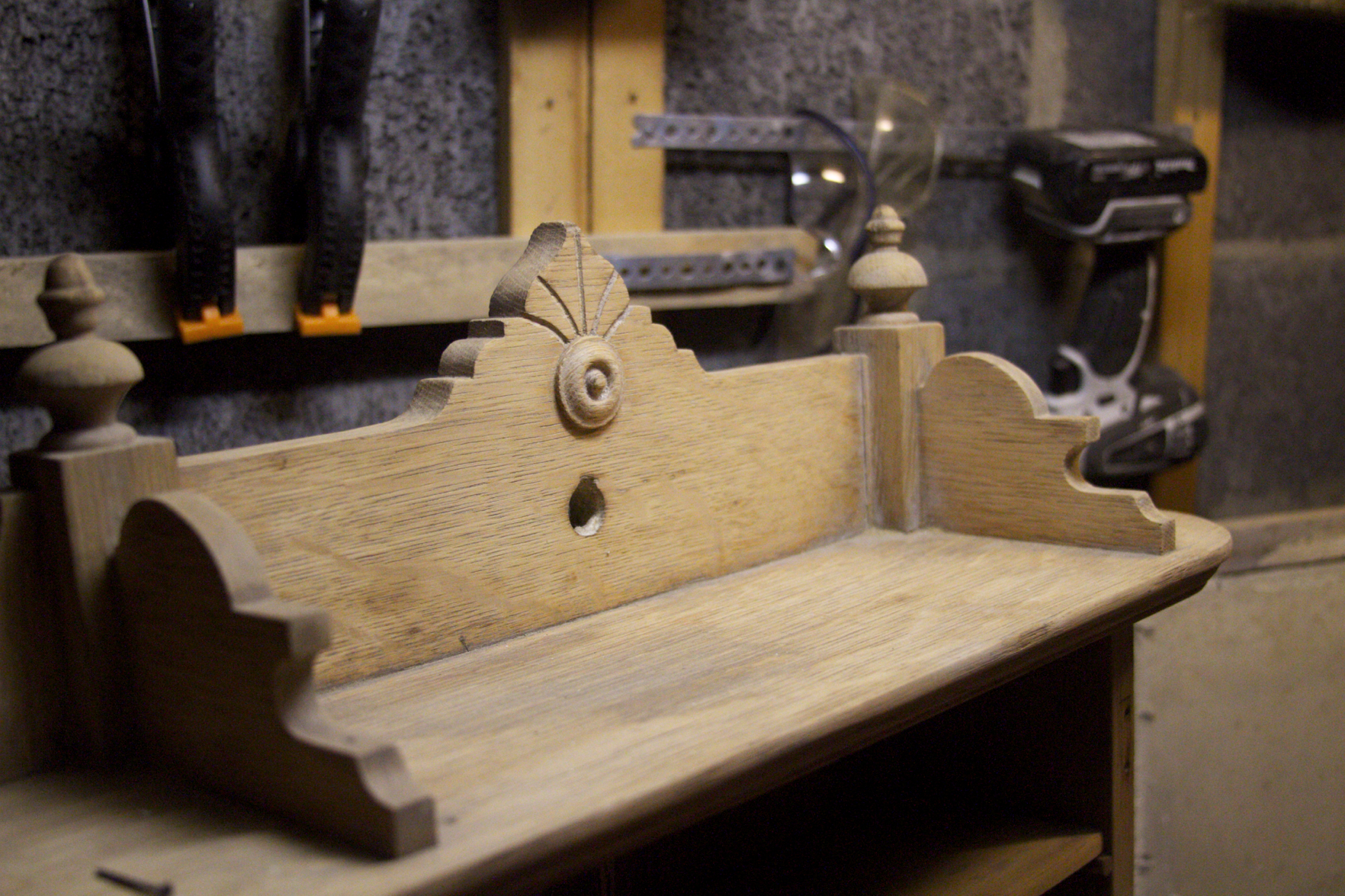
I’m really interested in the woodwork from that particular gut reno, because the house was built around the same time as ours, and by the same builder. I figured it’s the best chance to find the closest match for what is not longer here. Once I strip my little find, replace the plywood with a mirror, and cajole the hubs to rebuild the side and back, it will be pretty once again.

(besides covered in an unholy amount of paint)
This mystery bit of hardware is attached to the chair rail in our tiny bathroom. It never occurred to me, until now, to wonder why there is chair rail in our 27 square foot bathroom. Maybe to top off long-gone bead board? The location of the bathroom is original to the house, and the chair rail matches the type in the kitchen and dining room.
Anyway, this strange object is attached to both sides of the pocket door (one by the toilet side, one by the sink side).

It looks like it’s meant to hold something, but what? Can’t be a towel hook, because it would make the towel hang almost in the toilet.
I spent way too much time poking around online vintage plumbing suppliers to see if I could find a fixture that looked like it might fit. I didn’t find anything, however, I did come across the worst plumbing-related invention ever. Behold, the folding urinal:

from Vintage Plumbing
The Victorians never cease to amaze.
Brooklyn Daily Eagle, Jan 26, 1897
(this is totally random)
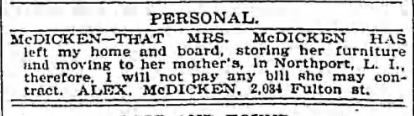
I am trying to find clues to confirm that the architect of our house was Henry Hill (the son, as in Amzi Hill and Son – the prolific architects of this part of Brooklyn). I thought perhaps I could find sales ads for some other houses by the same developer and look them up on Street View to see if McDicken (the developer) just kept building the same design (perhaps paying for it once and repeating it over and over).
In my search for Daniel McDicken, I came across this nugget of a personal ad. It seems as Daniel’s brother Alexander was having some issues with his wife, and he felt strongly that he should not be financially liable. Turns out Lana McDicken’s husband was a piece of work. Newspaper articles note that he was held in contempt of court, while serving on a jury (basically for talking trash), and years later was also sued for 10,000 (for slander). From the looks of things, Alexander liked to run his mouth quite a bit, and I think the tone of the ad above paints quite a vivid picture of what he might have been like. It cracked me up.
Who said you need social media to over-share?
(as for my fruitless search, all I found so far is a Neo Grec 4 story house on Monroe street. Thus far my theory is not panning out)
While picking through a pile of house parts that were in route to the dumpster, a Brownstone Detective found this:

It’s a section of the tile that surrounded a fireplace, with the wall still attached to it. It was covered in silver paint, probably spray paint. I know from the real estate listing photos that it was the tile that complimented the fireplace mantel currently disassembled in my cellar (one of the three Killian Brothers mantels I brought home). There was quite a bit of non-painted tile intact (not that it matters, because paint comes off tile quite easily).
It took about 15 minutes, some nail polish remover, a metal scraper and a Mister Clean Magic Eraser sponge. Now it looks like this:
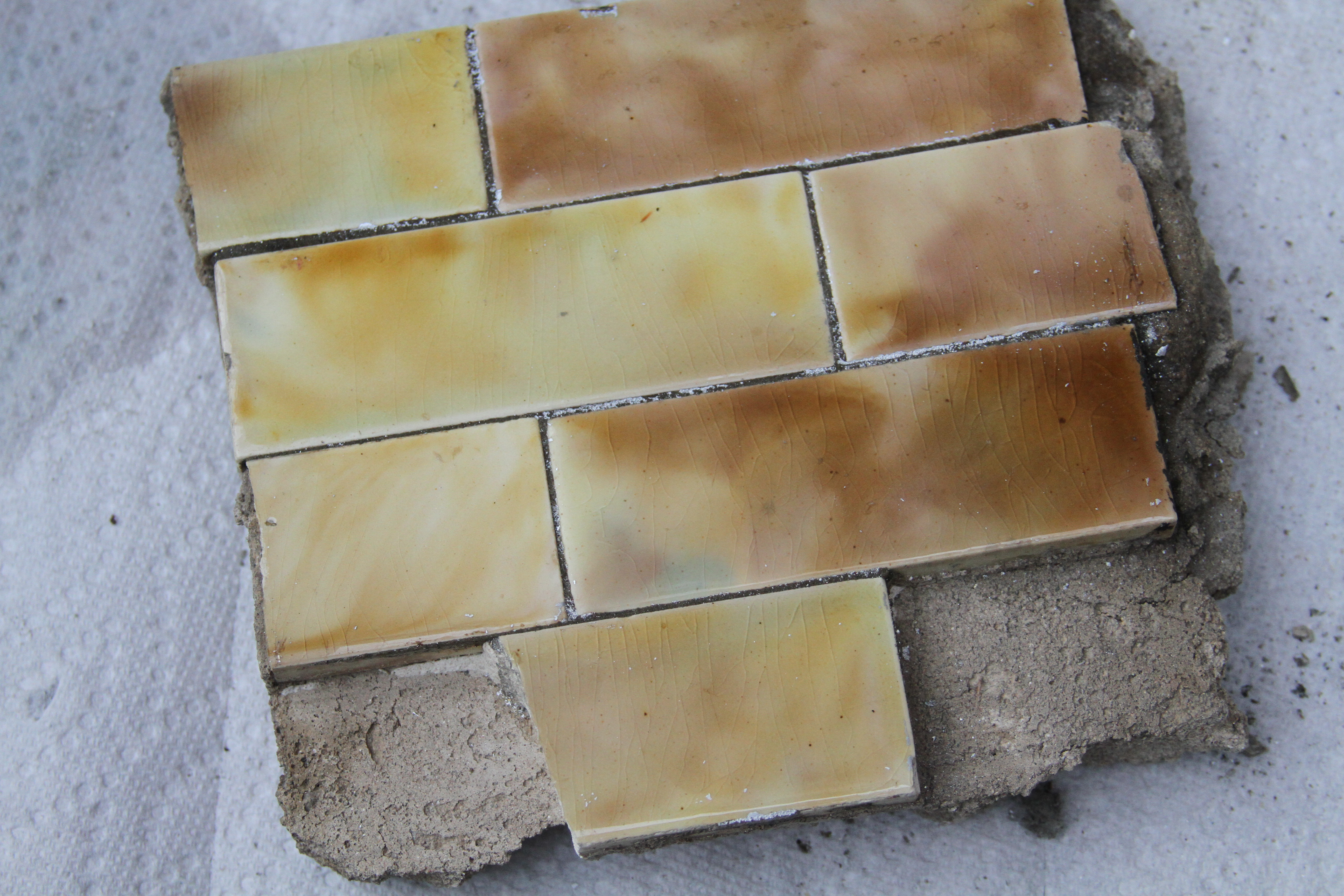
It’s the same style of tile of three of our fireplaces (parlor and garden), but it’s not an exact match: colors are similar, but it’s a much larger size. It’s also still attached to about an inch of cement. I have no idea what I’m going to do about that. I love love love love old tile. I have no use for it (due to the color/size discrepancy, not to mention the hunk of wall that comes with it) yet I’m happy I have it.
(which is probably what all headers say about every bit of useless crap they own).
(on a side note, I wonder if the people removing all this stuff know that one little piece of tile like this retails for between $7-9? And that the two large flower relief tiles that were part of this set sell for about $50 each?)
(sad)
All the salvage accumulating in our cellar comes infested with nails. Lots and lots of freaking nails. It seems that no job was too small for a 3-inch nail; nor, it seems, were nails in short supply: better secure that little strip of trim with as many (gigantic) nails as humanly possible. So yes, 9 billionty nails pulled, or approximately a little less than half of the pile.
(9 billionty nails = 6 blisters)
(The nails win. For now.)
Anyway, while I was toiling way with the stupid nails in the cellar, the hubs was surprising me with a new (old) light fixture.

This purdy little thing was a salvage find from a couple of years ago, on a trip to Detroit. It was in need of a good cleaning and some new sockets and wires.
It is going in the bedroom, where it will be replacing the cheap and generic Ikea fixture that was there before. (one day we’ll be living in a house that doesn’t rely so heavily on blah-Ikea… Oh, I kid. That will never happen.)
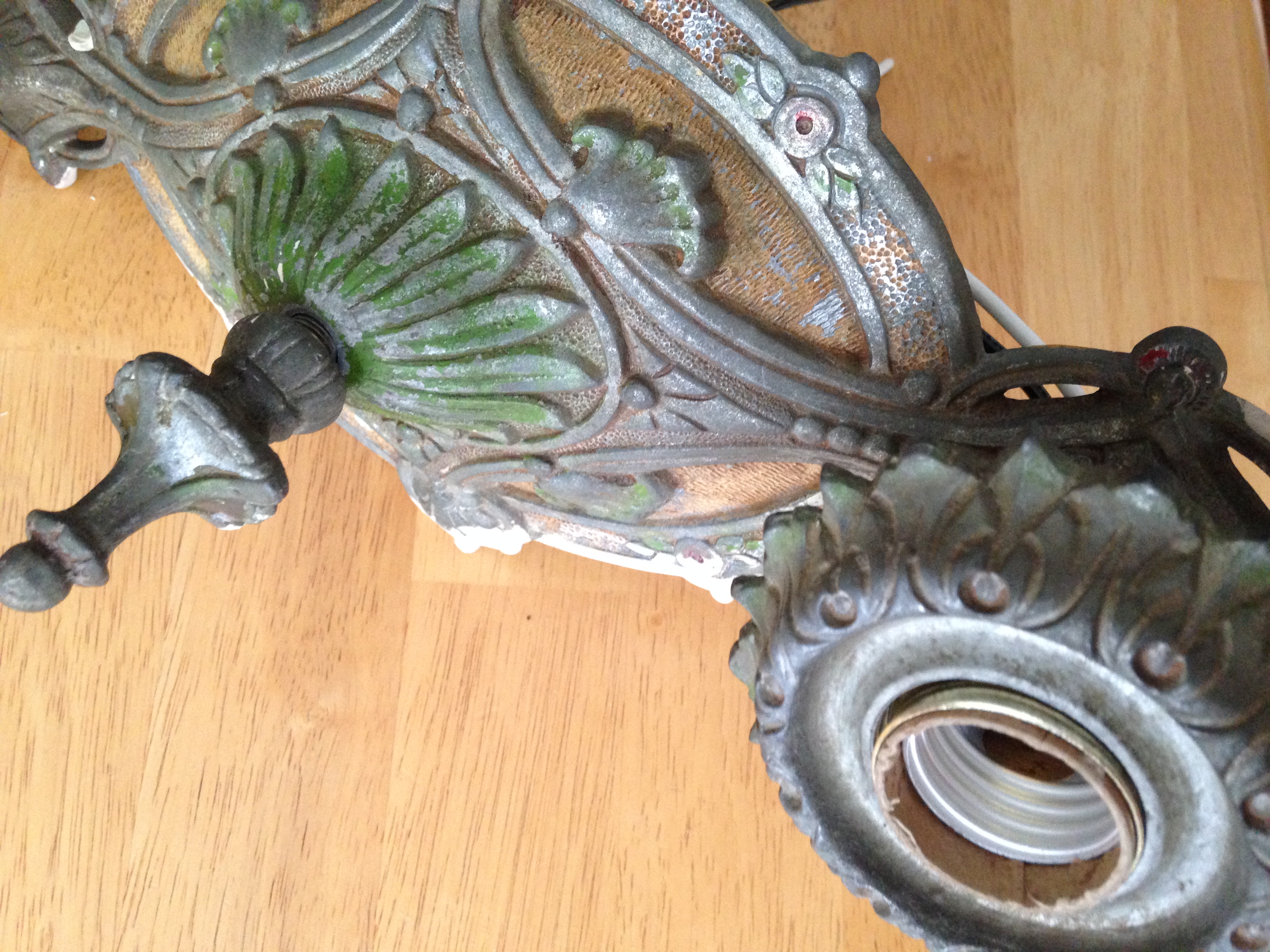
After a good cleaning, what looked like a gray rusty fixture, turned out like this:
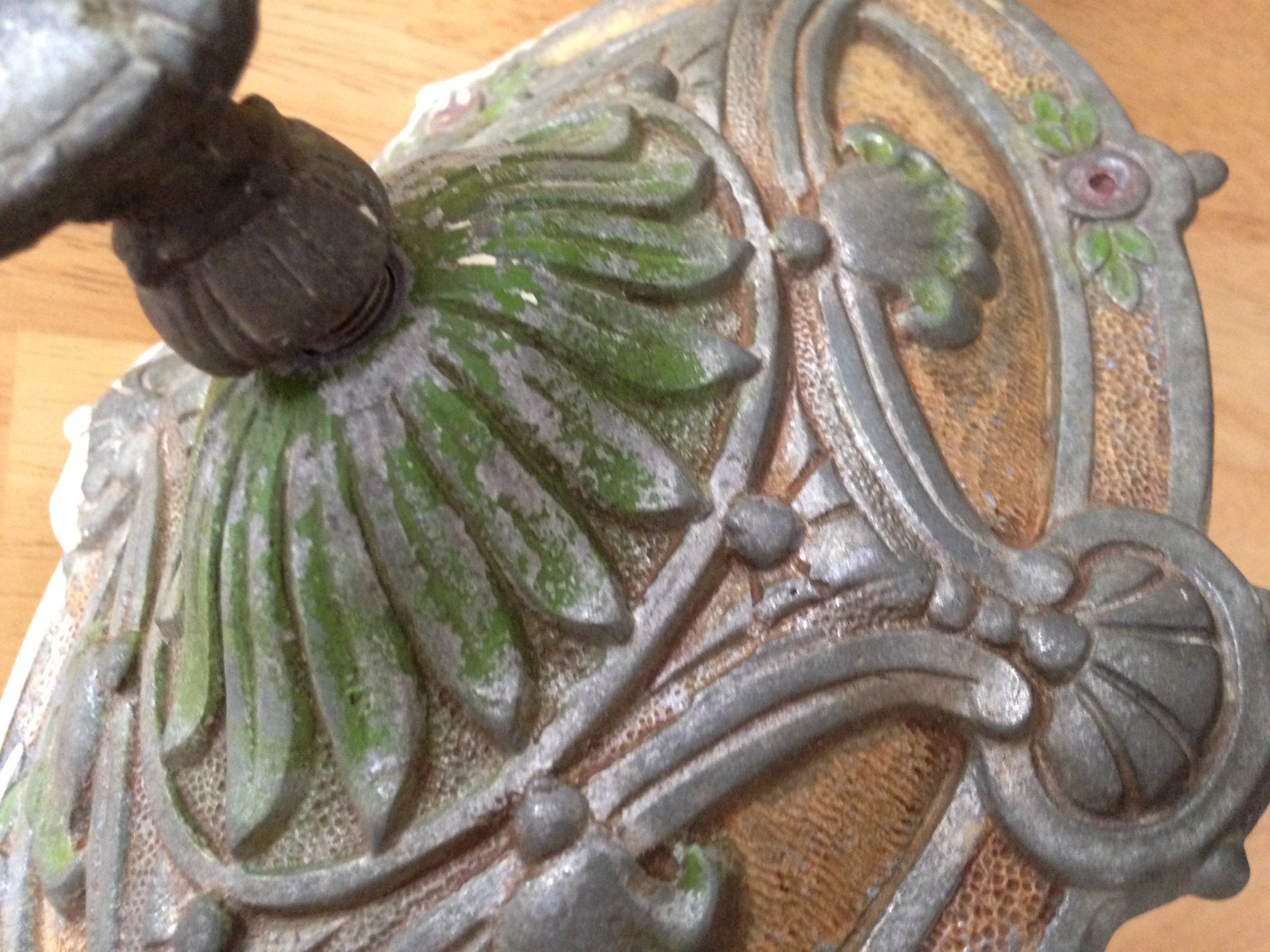
I like the subtle hints of green, gold and red, so I think we’ll keep it like this (rather than restore to full color).
However, as you might have noticed in some of the photos, at some point someone was less than neat with their ceiling pant job and got a big slop of institutional beige on the side (beige, the color of boring).
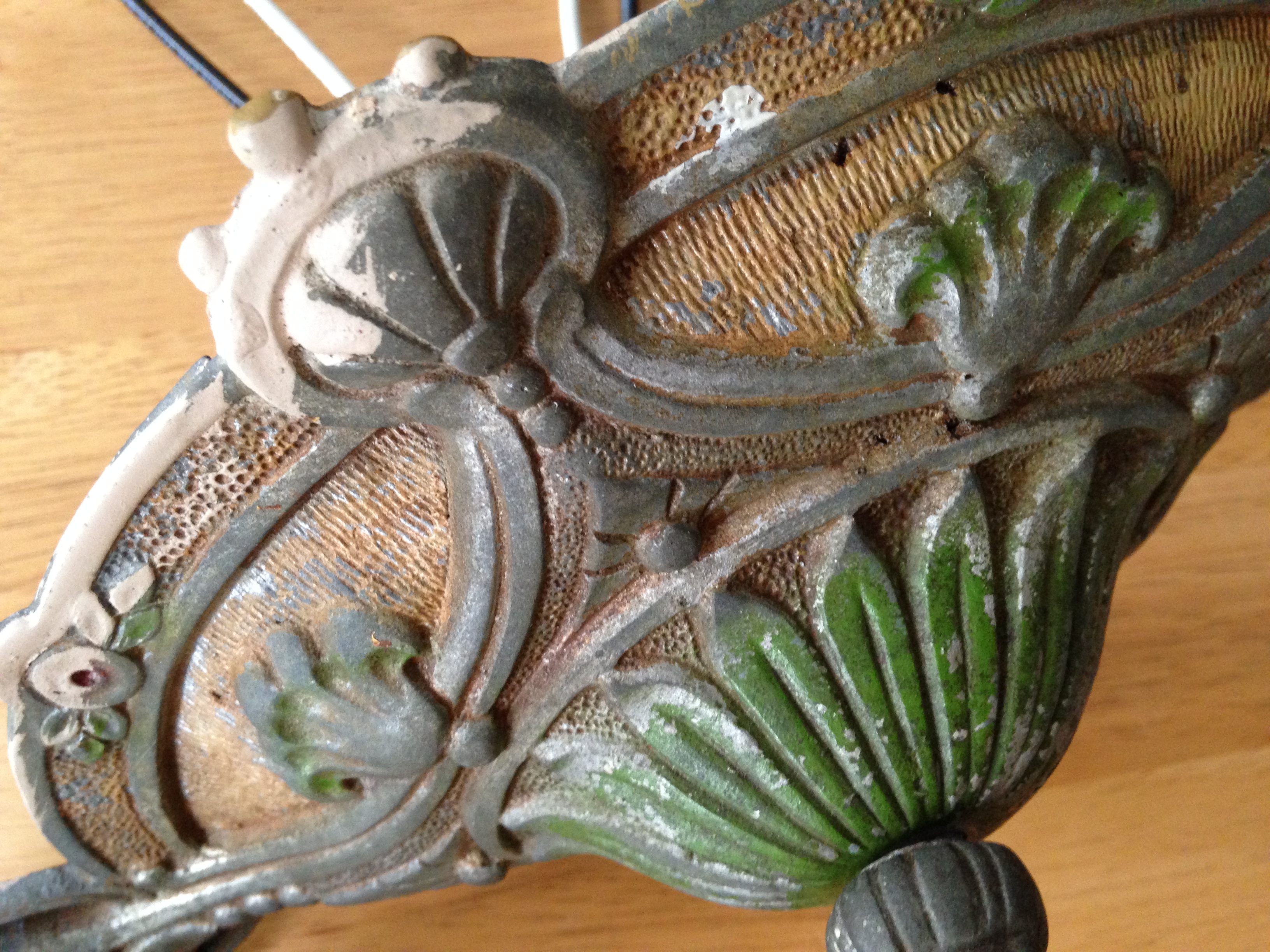
As someone who is fascinated with all manners of paint removal, I’m stumped by this one: how am I going to remove the ugly and keep the pretty?
I found these ads in the Real Estate Record and Guide. A quick check of some of my neighbors fireplaces, and it seems that the Kilians’ were the go-to purveyors of fireplace surrounds of the late 1880s and early to mid 1890s.
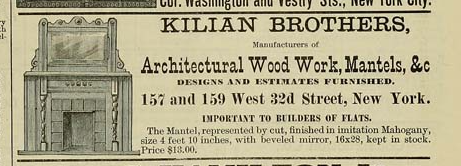
Real Estate Record and Builders’ Guide (July 6, 1889)

Real Estate Record and Builders’ Guide (January 3, 1891)
Another house in my area is getting fully gutted. Hopefully they will keep the fireplaces intact. All the walls, trim, everything: gone. Trying to save what I can, will eventually run out of room to store all this stuff…
Update: they are keeping the fireplaces. Yey! Not only that, they have an intact one in the rear parlor (meaning it has the mirror topper, as pictured above). The demo crew was kind enough to let me peek inside. Befriending demo crews is becoming a skill I get to practice quite a bit as of late.
 A Pink Brownstone in Brooklyn